
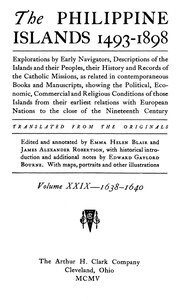
The Philippine Islands, 1493-1898, Volume 29 of 55, 1638–40 by Emma Helen Blair et al.
Let's be clear: this isn't a novel with a single plot. "The Philippine Islands, 1493-1898, Volume 29" is a curated stack of primary sources from 1638 to 1640. Edited by Emma Helen Blair and her team, it presents the actual documents written by governors, bishops, soldiers, and merchants. There's no narrator guiding you; you're left to piece together the story from these frantic, often contradictory, memos from the past.
The Story
The 'story' is survival. The Spanish colony in Manila is under immense pressure. From the outside, Dutch and Moro pirates are constantly raiding ships and coastal towns, strangling trade and spreading fear. From the inside, the colonial government is a tangle of conflict. The Spanish governor and the Catholic religious orders (like the Dominicans and Jesuits) are in a near-constant feud over authority, land, and how to deal with both the local population and new arrivals. Speaking of new arrivals, a group of Japanese Christians, exiled from their homeland, arrives in Manila, adding another layer of cultural and political tension to an already volatile mix.
Why You Should Read It
You should read it for the noise and the chaos. Textbooks smooth everything out into clear cause and effect. This book gives you the shouting match. Reading a bishop's furious letter about the governor's incompetence, followed by the governor's defensive report to the King of Spain, is incredibly revealing. You see how personal pride, cultural misunderstanding, and sheer distance from Europe shaped decisions that affected thousands of lives. The documents on the pirate attacks aren't clinical summaries; they're desperate pleas for reinforcements and lists of losses that feel immediate and human.
Final Verdict
This is not for the casual beach reader. It's for the curious explorer who doesn't mind doing a little archaeology. Perfect for history buffs who are tired of second-hand accounts, for writers looking for authentic period voice and detail, or for anyone with Filipino heritage wanting to hear the unfiltered (though colonially-filtered) voices from a pivotal era. It requires patience, but the reward is an intimacy with the past that few polished histories can ever provide.
This text is dedicated to the public domain. Access is open to everyone around the world.
Matthew Lee
11 months agoIt’s refreshing to see such a high standard of digital publishing.
Nancy Martin
8 months agoThe research depth is palpable from the very first chapter.
Donald Martin
1 year agoI started reading this with a critical mind, the structural organization allows for quick referencing of key points. It’s a comprehensive resource that doesn't feel bloated.
Jennifer Anderson
2 years agoIt’s rare to find such a well-structured narrative nowadays, the objective evaluation of the pros and cons is very refreshing. Finally, a source that prioritizes accuracy over hype.




Ashley Thompson
2 years agoLooking at the bibliography alone, the wealth of information provided exceeds the average market standard. This is a solid reference for both beginners and experts.