
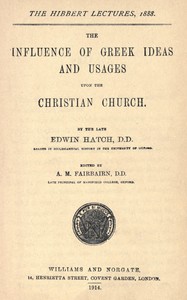
The influence of Greek ideas and usages upon the Christian church by Edwin Hatch
Let's be honest, most of us picture the early Christian church as a simple, pure thing that got complicated later. Edwin Hatch, a 19th-century scholar, throws that idea out the window. His book isn't a story with characters, but a detective story about ideas. The 'plot' follows the journey of Christian thought as it left its Jewish homeland and walked straight into the bustling intellectual marketplace of the Greek-speaking Roman Empire.
The Story
Hatch tracks how Greek ideas, which were just in the air everyone breathed, started sticking to Christianity. He looks at specific areas: how Greek philosophical terms were used to explain Jesus's nature, how Greek models of private clubs and societies influenced church organization (think bishops and deacons), and how Greek methods of argument and education shaped Christian theology. He argues that to make itself understood to educated Greeks, Christian leaders naturally used the concepts and language of Greek philosophy, especially Platonism. Over time, these borrowed tools didn't just explain the faith—they began to reshape what the faith itself emphasized and how it defined truth.
Why You Should Read It
This book is a powerful reminder that no belief system exists in a vacuum. Reading Hatch, you see Christianity not as a static set of truths revealed once, but as a living conversation that was deeply affected by its cultural context. It makes the early church feel real and human, grappling with huge questions in the language they had available. It also helps explain why later church arguments could get so technical—they were using a Greek intellectual toolkit. For me, it added a fascinating layer of history to my understanding of religion, showing the practical, almost accidental, ways a religion's identity forms.
Final Verdict
This is not a light read. It's for the curious reader who loves history, religion, or ideas. Perfect for anyone who has asked, 'Why does my pastor sound like a philosopher sometimes?' or for fans of books that connect the dots between different parts of history. If you enjoyed the big-picture thinking of something like Jared Diamond's Guns, Germs, and Steel but for religious history, you'll find Hatch's thesis thrilling. Be prepared for some dense passages, but the 'aha!' moments are absolutely worth it.
Legal analysis indicates this work is in the public domain. Feel free to use it for personal or commercial purposes.
Donald Thompson
1 year agoAs a long-time follower of this subject matter, the breakdown of complex theories into digestible segments is masterfully done. This has become my go-to guide for this specific topic.
Paul Davis
3 weeks agoFinally found a version that is easy on the eyes.
Paul Harris
1 year agoAfter finishing this book, the depth of research presented here is truly commendable. Highly recommended.
Joshua Thompson
1 year agoThis book was worth my time since the plot twists are genuinely surprising. I learned so much from this.




Richard Martin
1 year agoThe balance between academic rigor and readability is perfect.