
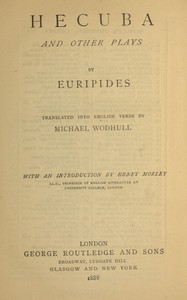
Hecuba and other plays by Euripides
Let's be clear: this isn't a feel-good read. Euripides drops us into the absolute worst day of Queen Hecuba's very long, very bad week. The Trojan War is over. Troy has fallen. Her husband and son are dead. Most of her children are gone. Now, she's a slave, waiting on the shores of a foreign land with the other captured Trojan women, completely at the mercy of the Greek generals.
The Story
The main play, Hecuba, hits us with two crushing blows. First, Hecuba learns that her last living son, Polydorus, has been murdered for gold by a man she considered a friend. Before she can even process that horror, her daughter Polyxena is demanded as a human sacrifice to appease the ghost of the Greek hero Achilles. Hecuba's pleas are ignored, and she is forced to watch her daughter walk to her death with terrifying courage. Stripped of every last shred of her former life and dignity, Hecuba's profound grief transforms. She plots a brutal, shocking revenge against her son's killer, proving that a cornered mother is the most dangerous force of all. The other plays in the collection, like Electra and The Trojan Women, explore similar terrain—the cyclical nature of violence and the devastating cost of war, especially on those who never asked to fight.
Why You Should Read It
What stunned me is how immediate it all feels. Euripides isn't interested in glorifying war or heroes. He's interested in the survivors, the collateral damage. Hecuba isn't a symbol; she's a shattered person. We watch her sanity fray in real time. Her revenge isn't presented as heroic justice—it's a tragic, monstrous act born from unbearable loss. The play forces you to sit with that complexity. There are no easy answers, just a deeply uncomfortable look at how violence begets violence. It's a powerful, bleak reminder that the true cost of any war is measured in human suffering, long after the battles are done.
Final Verdict
This is perfect for anyone who loves character-driven stories where morals are gray and endings aren't neat. If you enjoyed the psychological tension of Medea or the anti-war sentiment of modern stories, you'll find a kindred spirit in Euripides. It's also a fantastic, accessible entry point into Greek tragedy—the language (in a good translation) is direct and the emotions are unmistakably human. Just don't expect a happy ending. Bring a strong cup of tea and maybe a blanket for this one; it's a brilliant, brutal journey.
This masterpiece is free from copyright limitations. You can copy, modify, and distribute it freely.
Paul Johnson
6 months agoI've been looking for a reliable source on this topic, and the critical analysis of current industry standards is very timely. Truly a masterpiece of digital educational material.
Jennifer Wilson
6 months agoA sophisticated analysis that fills a gap in the literature.
Patricia Taylor
5 months agoGiven the current trends in this field, the narrative arc keeps the reader engaged while delivering factual content. A trustworthy resource that I'll keep in my digital library.
Daniel Torres
5 months agoGreat reference material for my coursework.










Charles Rodriguez
3 months agoThe clarity of the concluding remarks is very professional.