
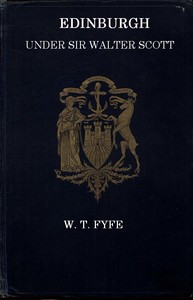
Edinburgh Under Sir Walter Scott by W. T. Fyfe
So, what's this book actually about? It's not your typical biography. Instead of a straight timeline of Scott's life, it paints a portrait of Edinburgh during his lifetime (1771-1832). The author, W. T. Fyfe, acts as a guide, showing us how the city's unique character—its history, its social divides, its intellectual fervor—shaped Scott and how, in turn, his writing shaped the world's view of Scotland.
The Story
The 'story' here is the transformation of a city. We start in the late 1700s, in a cramped, medieval Edinburgh where people lived in towering tenements. This is the world of young Walter Scott. The book then follows the city's physical and social expansion into the graceful Georgian New Town. We see how Scott witnessed this shift, from the law courts and literary societies he frequented to the countryside he loved to explore. The narrative weaves together his personal milestones with major events in Edinburgh's life, creating a rich picture of the environment that produced novels like 'Waverley' and 'Ivanhoe.'
Why You Should Read It
I loved this because it made history feel immediate. It's not just dates and facts; it's about the smell of the streets, the arguments in the taverns, and the view from Scott's window. You get a real sense of the man not as a distant literary statue, but as a person walking to work, dealing with debt, and drawing inspiration from everything around him. It shows how a place can get inside a writer's soul. The book argues, convincingly I think, that you can't fully understand Scott's stories of knights and Highland rebels without understanding the Edinburgh that was wrestling with its own past and future right outside his door.
Final Verdict
This is a perfect pick for anyone who loves history, literature, or simply a great sense of place. If you've ever enjoyed a Walter Scott novel (or even just the idea of them), this book provides incredible context. It's also a treat for fans of Edinburgh itself, offering a deep dive into its most formative era. Think of it as the best kind of historical tour: one led by a knowledgeable friend who points out all the details you'd miss on your own.
The copyright for this book has expired, making it public property. Thank you for supporting open literature.
Edward Martinez
1 year agoWow.



David Lopez
8 months agoIf you're tired of surface-level information, it addresses the common misconceptions in a very professional manner. The insights gained here are worth every minute of reading.